
Marin County Marriage License Requirements
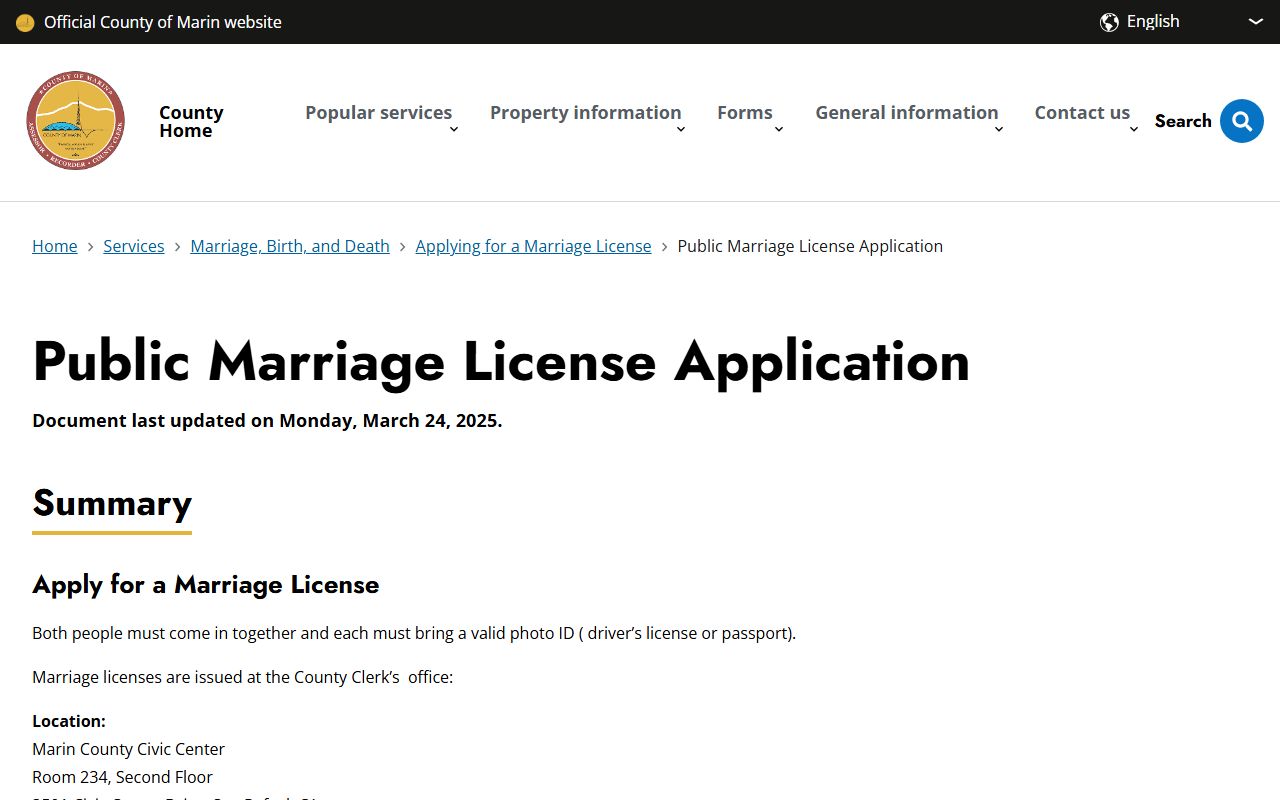
Marriage licenses are issued by the Marin County Clerk in Room 234 on the second floor of the Civic Center. Both people must appear together and bring valid, unexpired photo ID. If either person was divorced in the last few months, the Clerk asks for proof of the divorce, and no electronic copies are accepted. Applicants must speak English or Spanish or bring a translator. The license is valid for 90 days and must be used before it expires.
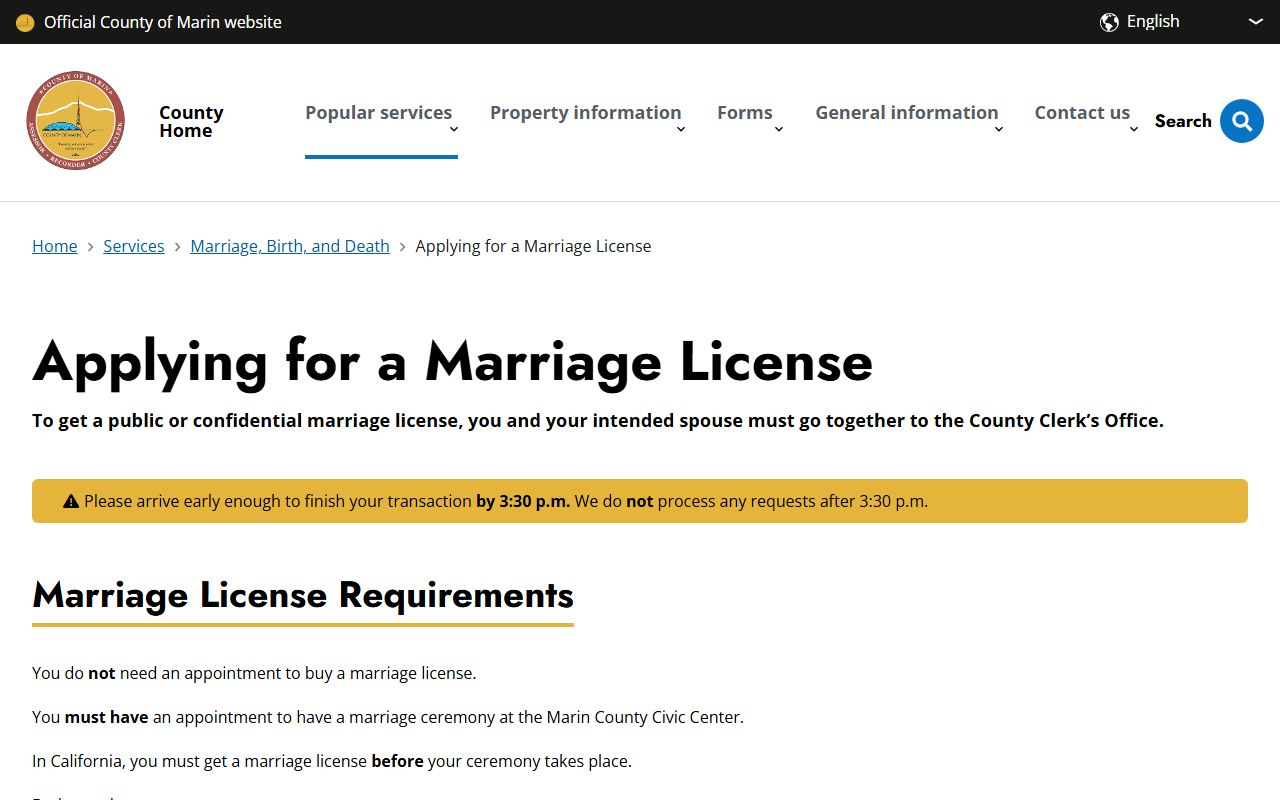
No appointment is needed to buy a license, but a civil ceremony at the Civic Center does require one. Plan to finish the transaction by 3:30 p.m., since the office does not process applications after that.
The accepted IDs, fees, and the online application link are on the Clerk's marriage page.
Requirements and the online option are posted on the Marin marriage license page.
Accepted IDs include a U.S. or foreign passport, a permanent resident card, a U.S. driver's license, a state ID card, or a consular ID card. A foreign driver's license is not accepted. Because the license expires after 90 days, it is best to apply close to the wedding date rather than months ahead.
How to Apply for a Marin County Marriage License
The process is short when you arrive prepared. Both people come together, show ID, complete the application, and pay the fee. The Clerk issues the license the same day, and the couple then has 90 days to hold the ceremony anywhere in California. A public license needs at least one witness at the ceremony, while a confidential license needs none. After the ceremony, the officiant returns the signed license so it can be registered, and a public marriage then becomes part of the Recorder's records.
- Choose a public or confidential license before you go.
- Both applicants appear together at the County Clerk, Room 234.
- Show valid, unexpired photo ID for each person.
- Bring proof of a recent divorce if either was divorced lately.
- Sign the application and pay the fee by 3:30 p.m.
Public vs Confidential Marriage Licenses
California offers two kinds of marriage license, and the difference is more than the fee. A public license becomes a public record once it is registered with the Recorder, and it needs at least one witness. A confidential license is not a public record, requires the couple to live together at the time of application, and needs no witness. Only the couple, or a person with a court order, can get a copy of a confidential record.
The public application page lays out the steps and links the PDF and online forms.
See the county's public marriage license application page for the public option.
| Public License | Confidential License | |
|---|---|---|
| Record status | Public once registered | Not a public record |
| Witness | At least one required | No witness required |
| Living together | Not required at application | Required at application |
| Who can get a copy | Authorized people under state law | Only the couple or a court order |
Marin County Marriage Record Fees
The Clerk and Recorder set separate fees for the license and for copies. Payment can be cash, a check payable to the Marin County Clerk, or a debit or credit card with a small processing fee. The amounts below cover the most common marriage transactions.
| Item | Fee |
|---|---|
| Public marriage license application | $85 |
| Confidential marriage license application | $93 |
| Copy of a marriage record | $19 |
| Marriage certificate | $19 |
| Card payment processing fee | $2.50 |
Note: county recording and vital record fees changed on January 1, 2026 under a new state law, so confirm the current amount before you pay.
Marriage License Application Fields
The application asks for the same core information whether you file the public or confidential form. The field inventory below is drawn from the official page and the standard form headings.
| Field Label | Type | Required | Notes / Format |
|---|---|---|---|
| License type | Selection | Yes | Public or confidential |
| Applicant legal names | Text | Yes | Names as shown on government ID |
| Identification | Document | Yes | Valid, unexpired accepted photo ID |
| Prior marriage or divorce | Text / date | Conditional | Proof needed if divorced recently |
| Signatures | Signature | Yes | Both people sign in person |
| Fee payment | Payment | Yes | $85 public or $93 confidential |
Certified Marriage Copies in Marin County
Once a public marriage is registered, the Recorder keeps the record and issues copies. California limits who can get an authorized certified copy. Under Health and Safety Code 103526, an authorized copy goes to the people on the record and a short list of others, such as a parent, a child, or a person with a court order. Everyone else can get an informational copy, which looks the same but is stamped to show it is not valid to establish identity.
That rule is about identity theft, not secrecy. An authorized copy can be used to prove a marriage for legal purposes, while an informational copy answers a research question without handing out a usable identity document. A confidential marriage record is stricter still, since only the couple or a court order can unlock it, so a relative cannot request that one.
Where to Find Marin County Divorce Records
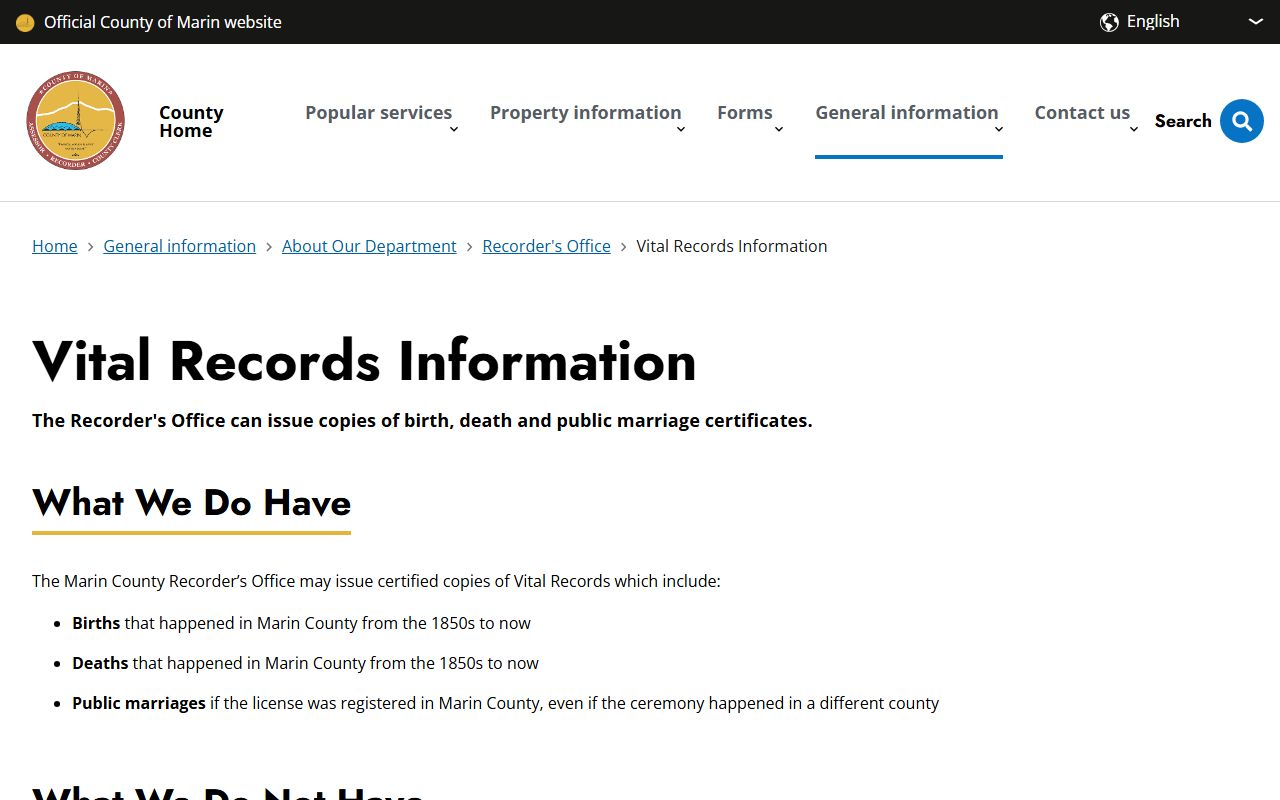
Here is the point that surprises people most. The Marin Recorder does not have divorce decrees. The Recorder's own vital records page sends divorce requests to the Marin County Superior Court. Divorce, legal separation, and nullity are Family Law Division matters, handled at the courthouse rather than the Recorder's office. A divorce decree is a court record, so it follows the court's records process, not the vital records process.
The Recorder's vital records page is clear about what it does and does not hold.
That distinction is spelled out on the county's vital records information page.
To request a divorce decree, you go through the court's Family Law Clerk in Room 113, not the Recorder. The clerk's phone is 415-444-7040, and the records request follows the same process as any court file. A certified copy of a dissolution judgment carries its own fee, and the court can confirm whether a case was filed and how it was resolved.
If you only need to confirm that a divorce happened, the court's case search can show the case and its disposition. For the actual decree, a records request or a courthouse visit is the route, since the document itself is a court record rather than a vital record at the Recorder.
Filing for Divorce in Marin County
A divorce case runs on California Judicial Council forms and local rules. The Family Law Division handles dissolution, legal separation, nullity, support, custody, parentage, and related matters. If you cannot afford the filing fee, the court accepts a fee waiver request on forms FW-001 and FW-003.
The basic path is the same for most cases, even though the details vary.
- Determine the case type, such as dissolution or legal separation.
- Complete the Judicial Council forms for that case.
- File in Room 113 or through eFiling if you qualify.
- Pay the filing fee or submit a fee waiver request.
- Serve the other party and file proof of service.
- Exchange disclosures and resolve custody, support, and property.
- Submit the judgment forms to finalize the case.
Family Law Self-Help in Marin County
You do not have to navigate a divorce alone. The court's Legal Self-Help Center and Family Law Facilitator help self-represented people with divorce, custody, support, and domestic violence matters. They explain the forms and the steps and make referrals, but they cannot give legal advice or represent you. The Family Law Clerk in Room 113 takes filings during regular office hours. The center offers drop-in, phone, and online clinics, and the California Courts Self-Help Guide adds free statewide material in several languages for people who want to read ahead. Fee waiver forms FW-001 and FW-003 are available for anyone who cannot afford the filing fee, so cost does not have to block a divorce case from moving forward.
For the full case file behind a divorce, see Marin County court records. For estate and conservatorship matters that overlap with family changes, see probate records, and for the office that issues licenses and keeps public marriage records, see the County Clerk-Recorder.