
How to Find Recent Marin County Arrest Records
The Marin County Public Booking Log is the official starting point. The Sheriff runs it and posts the people booked into the county jail in the last 48 hours who are still in custody, plus a full list of current inmates. The data is released under the California Public Records Act. The visible search field is last name, and it is optional, so you can also browse the recent list. Bail shown there can be approximate, so call the jail for an exact figure.
Arrest records are not the same as the full court file. The booking log captures the moment of arrest. The court case tells the rest of the story.
- Open the Sheriff's Public Booking Log from the Detention Bureau page.
- Enter a last name or browse the last 48 hours of bookings.
- Open a record to see the charges, the agency, and the bail.
- Note the next court date listed for the booking.
- Call jail information at 415-473-6653 for exact bail.
Marin County Booking Log Search Fields
The booking log keeps its inputs simple. You search by last name or use the built-in filters for recent and current custody. The fields below match what the Sheriff documents on the public page.
| Field Label | Type | Required | Notes / Format |
|---|---|---|---|
| Last Name | Text | No | Page reads "Last Name (optional)" |
| Last 48 Hours | Filter | No | Recent bookings still in custody |
| Currently In Custody | Filter | No | Full list of inmates as of the search time |
| Perform Search | Button | n/a | Runs the booking log query |
A booking record can list whether the person is still in custody, the charges booked, the arresting agency, the bail, and the next court appearance. For someone booked while under the influence, the log may note a minimum hold of about four hours before release.
Charges vs Convictions in Marin County Arrest Records
This is the single most important point on the page. An arrest is not proof of guilt. A charge is an accusation the prosecutor files. A conviction is a guilty plea or a verdict. People read an arrest record and assume the worst, but many arrests end without charges, and many charges end in dismissal or acquittal. The comparison below keeps the two straight.
| Charge | Conviction | |
|---|---|---|
| What it is | An accusation filed by the prosecutor | A guilty plea or a finding of guilt |
| Proof | Not proof of guilt | The legal outcome of the case |
| Where it shows | Booking log and early court entries | The case disposition in the court file |
To confirm how a case actually ended, check the court file rather than the arrest entry. The disposition lives in the Marin County court records, not in the booking log.
Arrest Records and Criminal Court Records
An arrest record and a criminal court record are different files held by different offices. The Sheriff books a person and creates the arrest and custody record. The Superior Court Criminal Division then handles the case, from arraignment to sentence. The Criminal Division page defines the three case levels: a felony is the most serious, a misdemeanor is mid-level, and an infraction is the lowest, usually a fine only.
The level changes how the case moves. A felony can carry a state prison term and runs through a felony courtroom. A misdemeanor carries up to a year in county jail. An infraction is usually a ticket with a fine and no jail. The Criminal Division also explains bail and fine payments and points to the forms used to clean up a record.
Case levels, bail, and dismissal references are on the court's Criminal Division page.
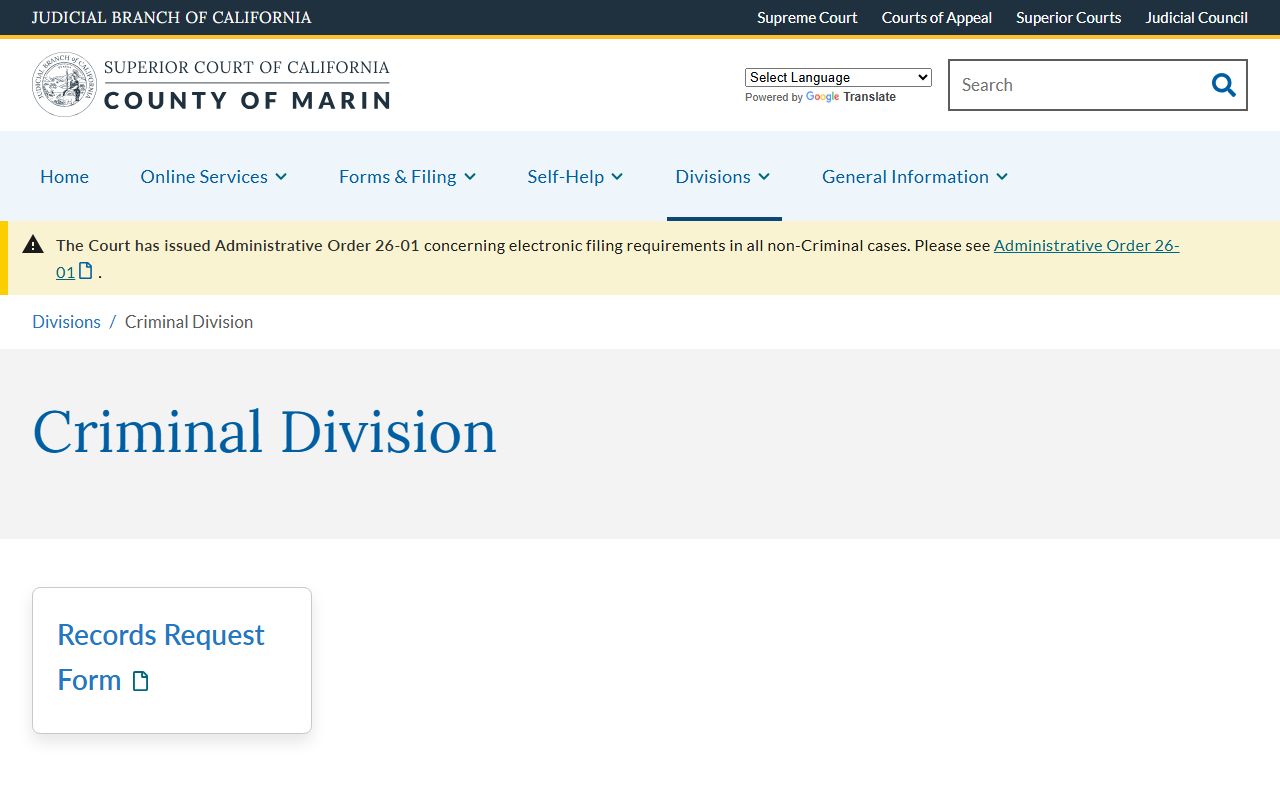
For the full charge history and disposition, the court file is the source, while the booking log only captures the arrest.
Mugshots and What Is Public
Booking data is public under state law, but the details that appear are limited. The Sheriff's public log lists custody status, charges, agency, bail, and the next court date. It does not promise a mugshot. Classification notes, medical and mental health data, internal movement, and protected identifiers are not public. Treat any third-party mugshot site with care, since those are not official and often charge to remove a photo.
If you need to confirm a booking, the Sheriff's own log and the jail phone line are the reliable sources. For the live roster and visitation rules, see the Marin County inmate records page.
Keep in mind that the booking log only covers recent and current custody. It is not a permanent archive. Once a person is released and the 48-hour window passes, the record drops off the recent list, even though the arrest still exists in the court file and the state history. For older arrests, the court case and the statewide record are the lasting sources.
The Marin County Booking and Bail Process
An arrest record begins at the jail. The Marin County Jail sits at 13 Peter Behr Drive on the Civic Center grounds, built underground into the hillside with a tunnel that moves people into the court areas. During intake, staff record the charges, the arresting agency, and custody details that feed the public booking log. Under Penal Code 851, an arrested person has the right to three free local calls to an attorney, a bail bond agent, or a relative.
Bail can be posted 24 hours a day for someone held in Marin custody or on a Marin warrant. The jail accepts full cash bail, a cashier's check or money order payable to the Marin County Jail, or a surety bond from a California-based company. The amount on the booking log may be approximate, so the jail asks people to call for the exact figure before they pay.
Sealed vs Expunged Marin County Records
California gives two main ways to clean up a record, and they are not the same. Sealing an arrest under Penal Code 851.91 applies when an arrest did not lead to a conviction. A dismissal under Penal Code 1203.4, which people often call expungement, applies after probation or a sentence is complete. A dismissal reopens the case, lets the person withdraw the plea, and dismisses the charge, but it does not erase every trace and does not restore firearm rights on its own.
| Sealed (PC 851.91) | Dismissed (PC 1203.4) | |
|---|---|---|
| When | Arrest with no conviction | After probation or sentence ends |
| Effect | Seals the arrest record | Withdraws plea and dismisses the charge |
| Limits | Exceptions apply by offense | Does not erase all history or restore gun rights |
The Public Defender's Clean Slate service helps eligible residents through this process.
Clean Slate and related help are described on the Public Defender services page.
The court directs people to Judicial Council forms CR-180 and CR-181 for a petition and order of dismissal, which are filed in the court where the conviction happened.
The District Attorney and Public Defender
Two offices sit on either side of a criminal case. The District Attorney prosecutes, and the Public Defender represents people who cannot afford a lawyer. Both are on the Civic Center campus. One important note from the DA: report a crime to the police agency with jurisdiction, not through the DA contact form.
The DA's address, hours, and victim contacts are on the office's contact page.
Reach the prosecutor through the Marin County District Attorney contact page.
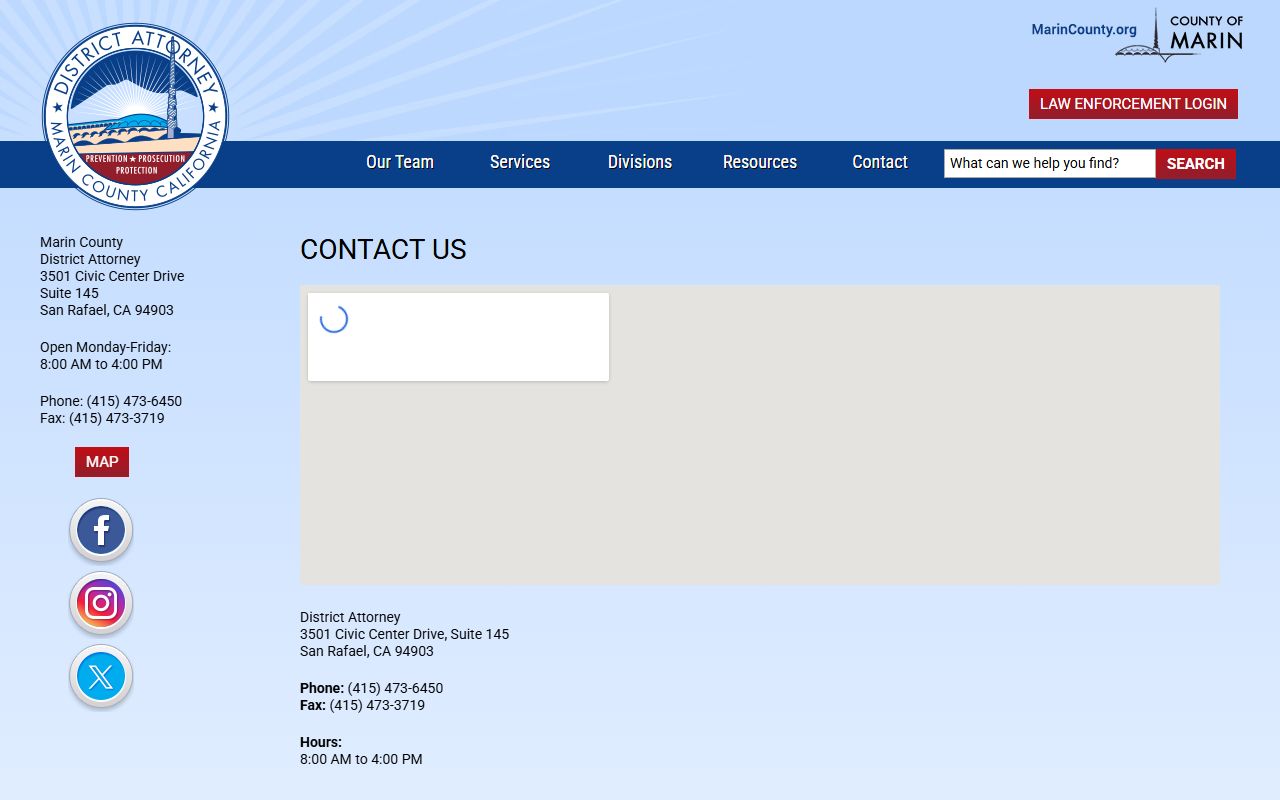
On the defense side, the Public Defender lists its full range of services.
Those services appear on the Public Defender homepage.
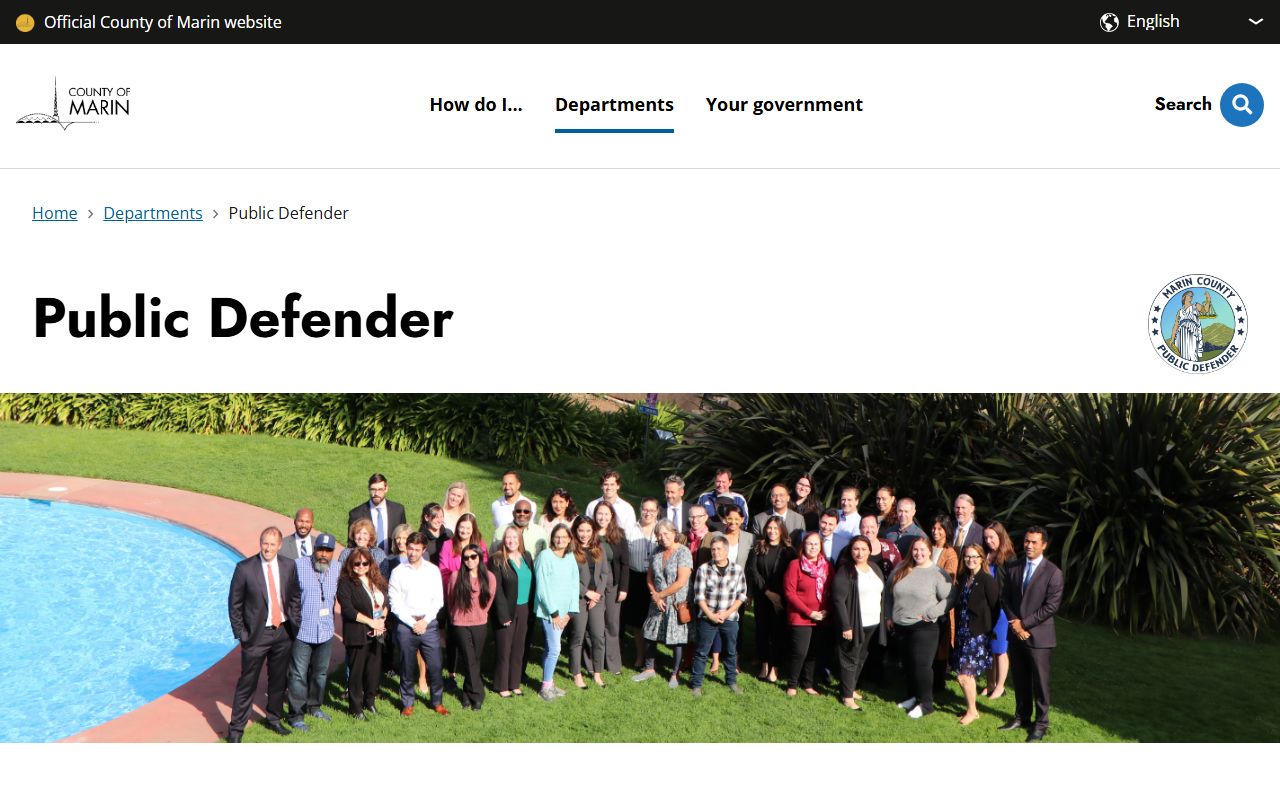
Marin County District Attorney
3501 Civic Center Drive, Suite 145
San Rafael, CA 94903
415-473-6450
Mon-Fri 8:00 a.m. to 4:00 p.m.
Marin County Public Defender
3501 Civic Center Drive, Suite 127
San Rafael, CA 94903
415-473-6321
Mon-Fri 8:30 a.m. to 4:00 p.m.
State Criminal Records and Background Checks
A full criminal history is a state record, not just a county one. The California Department of Justice keeps the statewide criminal history and runs the background check process for jobs and licenses that require it. A county arrest log shows local activity, while the state record pulls arrests and dispositions from across California. For the law behind public access, the state explains how the Public Records Act and the Information Practices Act work together.
That overview lives on the Secretary of State's law reference page.
See the state's California public records law reference for the framework.
For active orders that can lead to an arrest, see the warrant records page, and for DUI cases that cross into traffic, see traffic court records.
Note: A county booking log shows local arrests only, so a complete background check pulls from the statewide California Department of Justice record.